Topological Exploration of High-Dimensional Empirical Risk Landscapes: General Approach, and Applications to Phase Retrieval
Overview
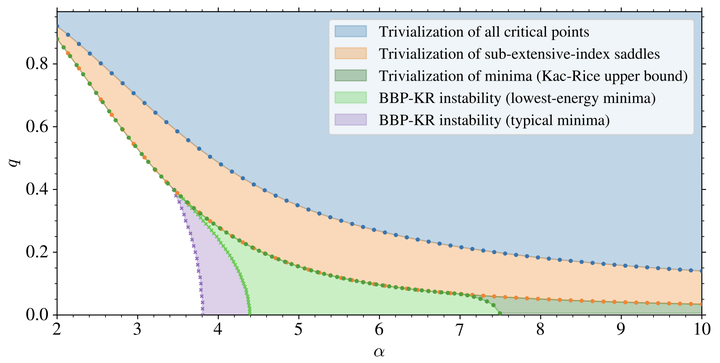
How many minima and saddles does a high-dimensional learning landscape contain, and what do they tell us about optimization? We develop a tractable framework based on the Kac–Rice formula to count and characterize these critical points. Applied to phase retrieval, it reveals transitions in landscape geometry and local stability, with predictions that closely match numerical experiments on gradient flow.
Type
Publication
arXiv:2602.17779