2

Topological Exploration of High-Dimensional Empirical Risk Landscapes: General Approach, and Applications to Phase Retrieval

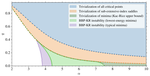
We consider the landscape of empirical risk minimization for high-dimensional Gaussian single-index models (generalized linear models). The objective is to recover an unknown signal $\boldsymbol{\theta}^\star \in \mathbb{R}^d$ (where $d \gg 1$) from a loss function $\hat{R}(\boldsymbol{\theta})$ that depends on pairs of labels $(\mathbf{x}_i \cdot \boldsymbol{\theta}, \mathbf{x}_i \cdot \boldsymbol{\theta}^\star)_{i=1}^n$, with $\mathbf{x}_i \sim \mathcal{N}(0, I_d)$, in the proportional asymptotic regime $n \asymp d$. Using the Kac-Rice formula, we analyze different complexities of the landscape -- defined as the expected number of critical points -- corresponding to various types of critical points, including local minima. We first show that some variational formulas previously established in the literature for these complexities can be drastically simplified, reducing to explicit variational problems over a finite number of scalar parameters that we can efficiently solve numerically. Our framework also provides detailed predictions for properties of the critical points, including the spectral properties of the Hessian and the joint distribution of labels. We apply our analysis to the real phase retrieval problem for which we derive complete topological phase diagrams of the loss landscape, characterizing notably BBP-type transitions where the Hessian at local minima (as predicted by the Kac-Rice formula) becomes unstable in the direction of the signal. We test the predictive power of our analysis to characterize gradient flow dynamics, finding excellent agreement with finite-size simulations of local optimization algorithms, and capturing fine-grained details such as the empirical distribution of labels. Overall, our results open new avenues for the asymptotic study of loss landscapes and topological trivialization phenomena in high-dimensional statistical models.

Why Diffusion Models Don't Memorize: The Role of Implicit Dynamical Regularization in Training

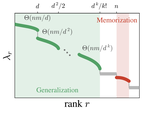
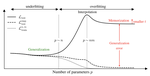
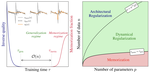
Diffusion models have achieved remarkable success across a wide range of generative tasks. A key challenge is understanding the mechanisms that prevent their memorization of training data and allow generalization. In this work, we investigate the role of the training dynamics in the transition from generalization to memorization. Through extensive experiments and theoretical analysis, we identify two distinct timescales; an early time τgen at which models begin to generate high-quality samples, and a later time τmem beyond which memorization emerges. Crucially, we find that τmem increases linearly with the training set size n, while τgen remains constant. This creates a growing window of training times with n where models generalize effectively, despite showing strong memorization if training continues beyond it. It is only when n becomes larger than a model-dependent threshold that overfitting disappears at infinite training times. These findings reveal a form of implicit dynamical regularization in the training dynamics, which allow to avoid memorization even in highly overparameterized settings. Our results are supported by numerical experiments with standard U-Net architectures on realistic and synthetic datasets, and by a theoretical analysis using a tractable random features model studied in the high-dimensional limit.